

Skip to content

University of Engineering & Management

The Future of world economy. A view from Stanford University.

Governments, businesses, and economists have all been caught off guard by the geopolitical shifts that happened with the crash of oil prices and the slowdown of China’s economy. Most believe that the price of oil will recover and that China will continue its rise. They are mistaken. Instead of worrying about the rise of China, we need to fear its fall; and while oil prices may oscillate over the next four or five years, the fossil-fuel industry is headed the way of the dinosaur. The global balance of power will shift as a result.

LED light bulbs, improved heating and cooling systems, and software systems in automobiles have gradually been increasing fuel efficiency over the past decades. But the big shock to the energy industry came with fracking, a new set of techniques and technologies for extracting more hydrocarbons from the ground. Though there are concerns about environmental damage, these increased the outputs of oil and gas, caused the usurpation of old-line coal-fired power plants, and dramatically reduced America’s dependence on foreign oil.

The next shock will come from clean energy. Solar and wind are now advancing on exponential curves. Every two years, for example, solar installation rates are doubling, and photovoltaic-module costs are falling by about 20 percent. Even without the subsidies that governments are phasing out, present costs of solar installations will, by 2022, halve, reducing returns on investments in homes, nationwide, to less than four years. By 2030, solar power will be able to provide 100 percent of today’s energy needs; by 2035, it will seem almost free — just as cell-phone calls are today.

This seems hard to believe, given that solar production provides less than one percent of the Earth’s energy needs today. But this is how exponential technologies advance. They double in performance every year or two and their prices fall. Given that California already generates more than 5 percent of its electricity from utility-scale solar, it is not hard to fathom what the impact of another few doublings would be: the imminent extinction of the fossil-fuel industry. Exponential technologies are deceptive because they move very slowly at first, but one percent becomes two percent, which becomes four, eight, and sixteen; you get the idea. As futurist Ray Kurzweil says, when an exponential technology is at one percent, you are halfway to 100 percent, and that is where solar and wind energies are now.

Anyone tracking the exponential growth of fracking and the gradual advances that were being made in conservation and fuel efficiency should have been able to predict, years ago, that by 2015, the price of oil would drop dramatically. It wasn’t surprising that relatively small changes in supply and demand caused massive disruptions to global oil prices; that is how markets work. They cause commodities futures and stock prices to fall dramatically when slowdowns occur. This is what is happening to China’s markets also. The growth of China’s largest industry, manufacturing, has stalled, causing ripple effects throughout China’s economy.

For decades, manufacturing was flooding into China from the U.S. and Europe and fueling its growth. And then a combination of rising labor and shipping costs and automation began to change the economics of China manufacturing. Now, robots are about to tip the balance further.

Foxconn had announced in August 2011 that it would replace one million workers with robots. This didn’t occur, because the robots then couldn’t work alongside human workers to do sophisticated circuit board assembly. But a newer generation of robots such as ABB’s Yumi and Rethink Robotics’ Sawyer can do that. They are dextrous enough to thread a needle and cost as much as a car does.

China is aware of the advances in robotics and plans to take the lead in replacing humans with robots. Guangdong province is constructing the world’s first “zero-labor factor,” with 1,000 robots which do the jobs of 2,000 humans. It sees this as a solution to increasing labor costs.

The problem for China is that its robots are no more productive than their counterparts in the West are. They all work 24×7 without complaining or joining labor unions. They cost the same and consume the same amount of energy. Given the long shipping times and high transportation costs it no longer makes sense to send raw materials across the oceans to China to have them assembled into finished goods and shipped to the West. Manufacturing can once again become a local industry.

It will take many years for Western companies to learn the intricacies of robotic manufacturing, build automated factories, train workers, and deal with the logistical challenges of supply chains being in China. But these are surmountable problems. What is now a trickle of manufacturing returning to the West will, within five to seven years, become a flood.

After this, another technology revolution will begin: digital manufacturing.

In conventional manufacturing, parts are produced by humans using power-driven machine tools, such as saws, lathes, milling machines, and drill presses, to physically remove material to obtain the shape desired. In digital manufacturing, parts are produced by melting successive layers of materials based on 3D models — adding materials rather than subtracting them. The “3D printers” that produce these use powdered metal, droplets of plastic, and other materials — much like the toner cartridges that go into laser printers. 3D printers can already create physical mechanical devices, medical implants, jewellery, and even clothing. But these are slow, messy, and cumbersome — much like the first generations of inkjet printers were. This will change.

In the early 2020s we will have elegant low-priced printers for our homes that can print toys and household goods. Businesses will use 3D printers to do small-scale production of previously labor-intensive crafts and goods. Late in the next decade, we will be 3D-printing buildings and electronics. These will eventually be as fast as today’s laser printers are. And don’t be surprised if by 2030, the industrial robots go on strike, waving placards saying “stop the 3D printers: they are taking our jobs away.”

The geopolitical implications of these changes are exciting and worrisome. America will reinvent itself just as does every 30-40 years; it is, after all, leading the technology boom. And as we are already witnessing, Russia and China will stir up regional unrest to distract their restive populations; oil producers such as Venezuela will go bankrupt; the Middle East will become a cauldron of instability. Countries that have invested in educating their populations, built strong consumer economies, and have democratic institutions that can deal with social change will benefit — because their people will have had their basic needs met and can figure out how to take advantage of the advances in technology.
May 3, 2018
News & Achievements
Official Update: Department of Civil Engineering, UEM Jaipur 📢
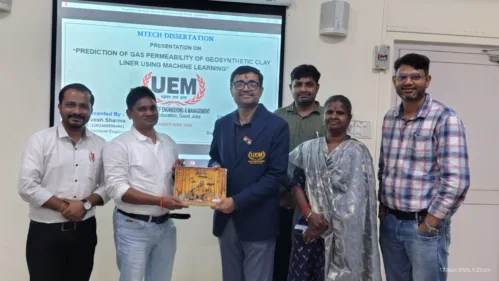
The Department of Civil Engineering, University of Engineering & Management (UEM), Jaipur, successfully conducted its PhD Six-Month Progress Report Evaluations and M.Tech Final Dissertation Defenses on September 17, 2026, at Academic Block-I, Main Building. 🌟 Key Highlights & Evaluation Board The academic sessions were graced by distinguished leadership, faculty members, and external expertise: External Expert: Dr. P.V. Ramanna (Associate Professor, MNIT Jaipur; Ph.D., IISc Bangalore) provided valuable insights on refining research scope and developing publication strategies. Dignitaries Present: Prof. Dr. Biswajoy Chatterjee (Hon’ble Vice-Chancellor, UEM Jaipur), Prof. Dr. G. Uma Devi, Dr. Uttam Narendra Thakur, and Prof. Subhro Chakraborty. Department Members: Dr. Shivam Chauhan, Prof. Sougata Banerjee, and Dr. Vishwajeet Khan (Online). 🎓 Academic Outcomes PhD Progress Reports: Mr. Juber Khan (Supervisor: Dr. Vishwajeet Khan) and Mr. Gawande Yogesh Bhagwanrao (Supervisor: Dr. Shivam Chauhan) successfully presented their research progress, which was thoroughly evaluated and approved. M.Tech Dissertation Defenses: Two M.Tech scholars, Sarvesh Sharma and Joydeep Jana, successfully defended their final dissertations before the expert evaluation board. 👏 Congratulations to all the research scholars and postgraduate students on their successful presentations! UEM Jaipur continues to foster research excellence and academic success. 🚀✨ Thanks & regards Prof. Sougata Banerjee #UEMJaipur #CivilEngineering #PhDProgress #MTechDissertation #ResearchExcellence #AcademicSuccess #IEMUEMGroup #ResearchScholars #HigherEducation #EngineeringEducation #UEMians
Read more
Sep 18, 2026
Awards & Achievements, Conferences, UEM Jaipur, University, University Daily News
UEM Jaipur successfully organized and conducted a National Workshop on “Advanced IPR Management and Commercialization
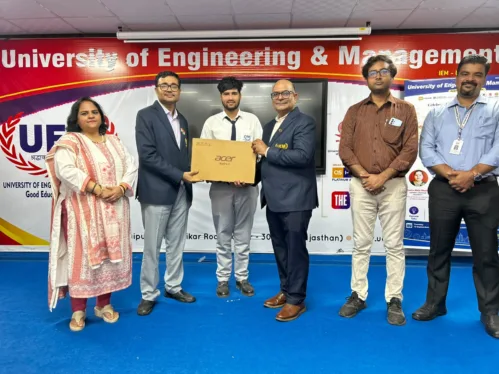
UEM Jaipur successfully organized and conducted a National Workshop on “Advanced IPR Management and Commercialization”, sponsored by the Department of Science & Technology (DST), Government of Rajasthan, on 30 March 2026. Today, Certificates of Appreciation were formally presented to all the coordinators in recognition of their valuable contributions, dedicated efforts, and effective coordination towards the successful organization and conduct of this significant academic event. 🌟 Special Appreciation: Prof. Dr. Govind Rai Goyal & Prof. Dr. Anurag Hamilton UEM Jaipur extends its heartfelt appreciation to Prof. Dr. Govind Rai Goyal and Prof. Dr. Anurag Hamilton for their exemplary efforts, valuable support, and dedicated contribution in planning and organizing the workshop. Their commitment, leadership, and effective coordination played an important role in ensuring the successful execution of this academic initiative. 👏 Congratulations and sincere thanks to all the coordinators for their dedication and contribution towards making the workshop a meaningful and successful academic endeavour. #UEMJaipur #IPR #IPRManagement #IPRCommercialization #DST #GovernmentOfRajasthan #NationalWorkshop #AcademicExcellence #ResearchAndInnovation #Innovation #IntellectualPropertyRights #FacultyAchievement #AcademicEvent #UEMPride #KnowledgeSharing
Read more
Sep 4, 2026
Conferences, University, University Daily News, Workshops & Seminars
More
Rankings
2026
University of Engineering and Management (UEM) Jaipur, IEM–UEM Group positioned rating in the *Platinum Band in India for Employability and Startup Ecosystem Excellence under the ESER 2026 – Employability and Startup Ecosystem Rankings 2026, awarded by World Institutional Ranking.
IEM Kolkata, School of UEM Kolkata was awarded with All India Rank 6 by prestigious Times all India engineering ranking.
2025
UEM Jaipur crowned as the INSTITUTION OF HAPPINESS (IOH) by the prestigious global ranking agency QS I-GAUGE at iconic Hotel The Lalit, New Delhi on 12th Dec 2025
IEM kolkata has been ranked within the top 50 best colleges of India by India Today.
University of Engineering and Management (UEM), Jaipur has been rated AAA+ one of the best engineering institutes in the country in 2025 by Carrer360- A Career is a Life
IEM, School of UEM Kolkata, has been ranked in NIRF 2025 National ranking framework.
University of Engineering and Management (UEM), Jaipur - IEM-UEM Group honored as the Most Promising University (Research and Development) 2025 at the ObserveNow 9th Education Leaders Conclave & Awards, presented by Casio India and co-powered by LEO1.
2024
UEM Jaipur has been ranked in India's Best University Ranking 2024 by OUTLOOK MAGAZINE.Private University - Constituent CollegesRank 41 - All India2nd in RajasthanTop 160 Private Engineering InstitutesRank 42 - All India3rd in Rajasthan Top 50 State Private University Rank 36 - All India, 3rd in Rajasthan Private University - Constituent Colleges Rank 41 - All India, 2nd in Rajasthan Top 160 Private Engineering Institutes Rank 42 - All India, 3rd in Rajasthan
University of Engineering and Management UEM Jaipur awarded as UNIVERSITY WITH BEST PLACEMENTS - DOMESTIC AND INTERNATIONAL in the MSME INDIA WEEK 2024 on THURSDAY 25.07.2024 in HOTEL RADISSON CITY CENTRE in JAIPUR.
UEM Kolkata ranked 43 in Top 175 - Govt and Private - All India Ranking 40 in Top 125 Private Institutions- All India Ranking 28 in Top 70 Private Institutions - Placement - All India Ranking 7 in Region wise Ranking
UEMK received 1st rank in the State of West Bengal and 3rd rank in Eastern and Central region.
Times Higher Education (THE) Global Ranking, Londan Ranked to the University of Engineering & Management, Jaipur for Diversity, Equity, and Inclusion (DEI) & Strong Institutions (SI) 2024
UEM Jaipur awarded with the CAMBRIDGE LEARNING PARTNERSHIP - EXCELLENCE AWARD under the category of SOUTH ASIA AWARDS 2023-24 by Cambridge University Press and Assessment for our Academic Association for the Cambridge LinguaSkill Tests and Assessments in New Delhi on 31st January 2024.
2023
Times Engineering Ranking 2023, UEM Jaipur Rank 29 out of Top 170 - Govt and Private - All India Ranking, Rank 27 out of Top 125 Private Colleges - All India Ranking, UEM Jaipur Rank 40 out of Top 70 Private College - Placement - All India Ranking.
UEMK received an all-India rank of 34 in the Emerging Engineering Colleges of India list as listed by India Today.
"1st in Rajasthan State, 3rd in All India (BCA & MCA Both)"
UEMK has been ranked 7th within the top 14 B-school in Eastern zone and ranked 20th within the top 36 Private University in India.
2022
UEMK ranked 3rd in Kolkata and 5th in East Zone
UEMK ranked 56 by India Today in the list of India’s Best University Ranking 2022.
UEMK ranked 2nd in the list of West Bengal’s Top 10 Private Engineering college by Economic Times on 22nd July, 2022.
Press Releases